
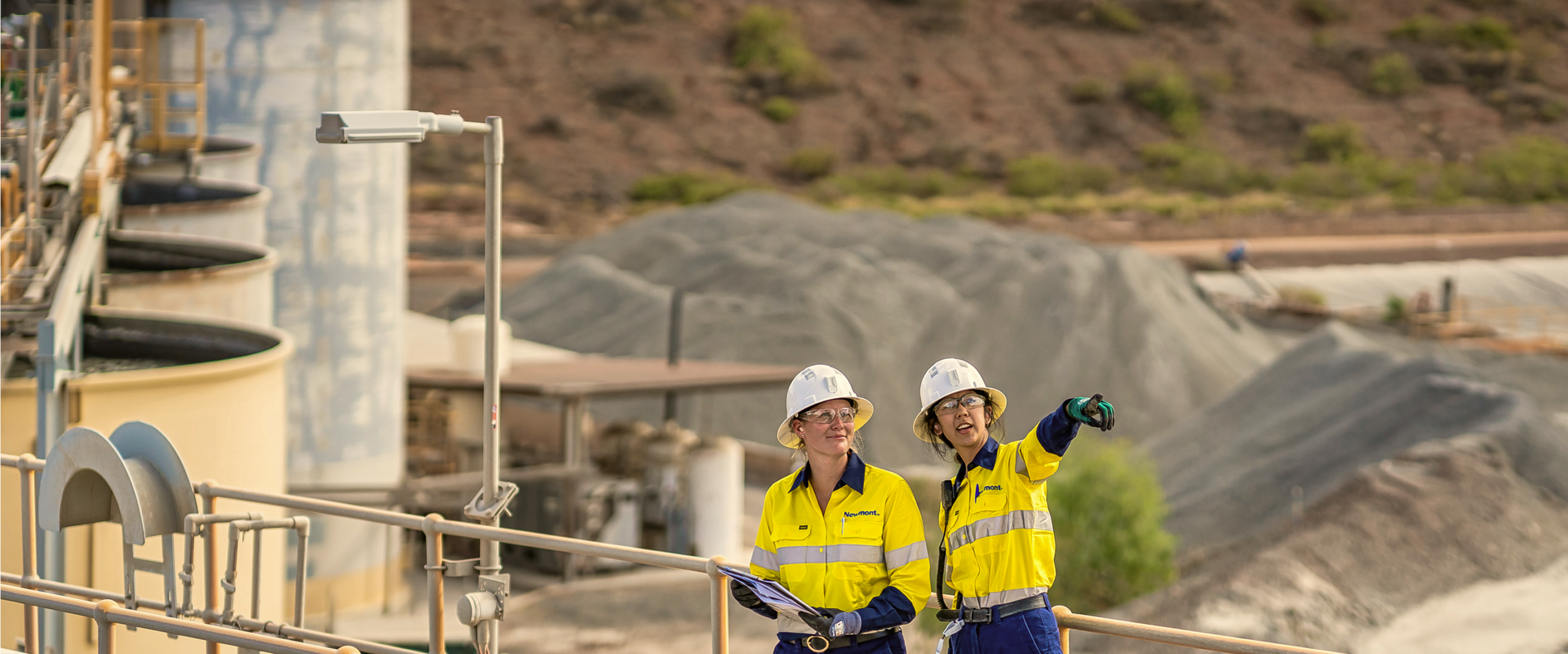
Newmont Tanami is a world-class Tier 1 underground mine in the Northern Territory, located 270 km from its closest neighbouring communities in the remote Tanami Desert of Australia. Tanami is a fly-in fly-out (FIFO) operation fully owned and operated by Newmont since 2002.
Once an open pit operation, the mine has been transformed into one of Australia’s largest underground gold mines.
The Tanami Expansion 2 is expected to secure Tanami’s future as a long-life, low-cost producer by extending its mine life beyond 2040 through the addition of a 1,460 metre hoisting shaft and supporting infrastructure to process 3.3 million tonnes per year and provide a platform for future growth. The expansion is expected to increase average annual gold production by approximately 150,000 to 200,000 ounces per year for the first five years (2028–2032) and significantly reduce operating costs through efficiency improvements.
- The Granites Gold Mine was developed and opened in 1986, with the high-grade Callie deposit discovered nearby shortly after by the site’s then-operator, Normandy Mining.
- In 2002 Newmont acquired Normandy Mining, gaining full ownership of the Tanami operations. Since then, Newmont has expanded the mine’s scale, depth and infrastructure, transforming it into a Tier 1 underground gold asset.
- Tanami’s current operations extend beyond 1.7 km underground, with extensions planned beyond 2 km.
- Ore is currently trucked from underground to the Granites processing plant, where it undergoes crushing, grinding, gravity recovery and carbon-in-leach processing.
- Tanami supports a workforce of more than 1,800 FIFO personnel, with the onsite airstrip allowing FIFO access from Perth, Darwin, Brisbane and Alice Springs.
- Increased throughput supported higher Q2 2026 production, with higher grades expected to drive Q4 performance.
- Second expansion is on track; underground infrastructure to be completed and commissioned in Q3 2026. This secures Tanami as a long-life, low-cost producer – extending mine life to ~2040.
- Reserves (FY 25): 5.3 million ounces of gold
- Resources (FY 25): 5.6 million ounces of gold
The Newmont Tanami mine and plant are located on Aboriginal freehold land owned by the Warlpiri people and managed on their behalf by the Central Desert Aboriginal Lands Trust.
Tanami is committed to building respectful and mutually beneficial relationships with the local people communities near its operations.
As part of our commitment to enable frequent communication with the community, a dedicated community relations team is based on site at Tanami’s operations to encourage ongoing dialogue with all our stakeholders to ensure our operations contribute positively to the community’s growth. The mine site is the most remote in Australia, with the closest communities of Yuendumu and Lajamanu approximately 370 km south and 390 km north-east of the mine.
Community Investment
Tanami contributes millions of dollars annually to Northern Territory economy through the employment of local citizens, the purchase of goods and services, payroll taxes, government royalties, land use payments, salaries and supporting community projects. Tanami invests directly and significantly in community initiatives that support community capacity-building activities, including scholarships, in-kind support and sponsorship grants.
In 2024, Tanami contributed over A$94 million in direct payments — including taxes and royalties — and around A$150 million annually to the Northern Territory economy. Community investment included A$500,000 in local initiatives and continued support for the Warlpiri Education and Training Trust, which has invested A$87 million since 2005.
Newmont Tanami maintains a strong commitment to environmental stewardship across all phases of the mine lifecycle, from exploration through to closure and rehabilitation. Environmental management at the site is guided by a systematic risk-based approach that prioritises compliance, sustainability, and continuous improvement.
In 2024, several new initiatives were introduced to enhance biodiversity disclosure, including alignment with Nature Positive principles and the Taskforce on Nature-related Financial Disclosures (TNFD). Closure planning and regional watershed management has been enhanced through the use of Light Detection and Ranging (LiDAR) and modelling to improve surface water drainage and landform stability.
Existing environmental monitoring programs focus on vegetation health, disturbance minimisation and tracking, borefield operations, groundwater management, and water stewardship. Compliance is maintained through rigorous analysis of analytical results, contamination controls and cyanide management practices. Emissions are tracked and reported under national frameworks, including the National Pollutant Inventory (NPI) and the National Greenhouse and Energy Reporting Scheme (NGERS), supporting transparency and accountability in environmental performance.
* As of Q2 2026. Latest Earnings Results | See Cautionary Statement